Payment reconciliation sounds simple: compare transaction records with settlement data, identify discrepancies and resolve them.
But as businesses expand across payment providers, markets, currencies and payment methods, the process quickly becomes more complex.
According to Kani Payments’ 2025 Reconciliation & Reporting Survey, 56% of surveyed UK payment businesses still rely at least partly on spreadsheets for reconciliation and reporting, while 82% struggle to meet reporting deadlines.
The challenge is therefore not simply to match records faster. It is to create a clear, reliable view of what happened to every payment – from the original transaction through provider processing to settlement.
What is payment reconciliation?
Payment reconciliation compares internal transaction data with settlement data received from payment providers. It helps businesses verify whether transactions were settled as expected and identify discrepancies that require further investigation.
The process becomes more challenging with every additional provider, payment method or merchant entity. Providers may use different transaction references, file formats, fee structures and settlement schedules. Refunds, chargebacks, currency conversions and rounding differences add further complexity.
Without a consistent process, Finance and Payment Operations teams can spend significant time downloading files, comparing records manually and investigating differences across multiple systems.
Why is payment reconciliation difficult with multiple providers?
Transaction volume matters, but fragmented data is often the bigger challenge.
One system may use a provider reference, another a merchant transaction ID. One report may show the gross transaction amount, while another reflects fees and the net settlement amount.
Kani Payments’ 2025 survey reflects this complexity: 23% of respondents identified cross-currency transactions as a leading barrier to accurate transaction matching, while 22% pointed to multiple payment channels.
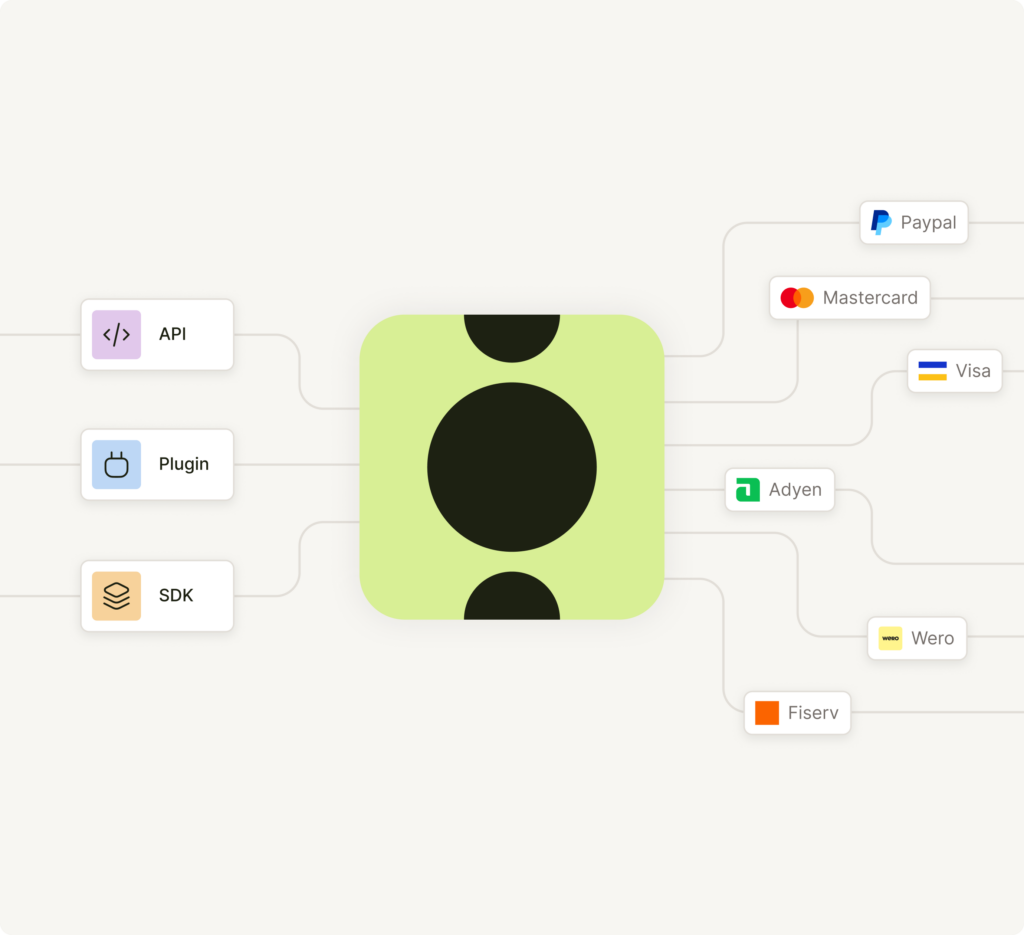
Before records can be reconciled, this information needs to be brought into a consistent structure. This is where a payment orchestration platform can support the wider payment operation.
Who needs payment reconciliation?
Payment reconciliation is particularly relevant for businesses that process payments across multiple providers, merchants, currencies or markets.
This includes marketplaces, PSPs and merchants with complex payment setups, where transaction and settlement data may be distributed across different systems and providers.
Within these organizations, reconciliation primarily supports two teams:
- Finance & Accounting use reconciliation to validate settlements, support financial close and maintain reliable financial records.
- Payment Operations use it to monitor provider activity, identify discrepancies and investigate payment exceptions.
The need becomes especially important as payment operations scale. Adding providers, payment methods, currencies or merchant entities increases the amount of data that needs to be connected and validated.
In short: the more fragmented the payment setup, the more important a consistent reconciliation process becomes.
How does Dinape support payment reconciliation?
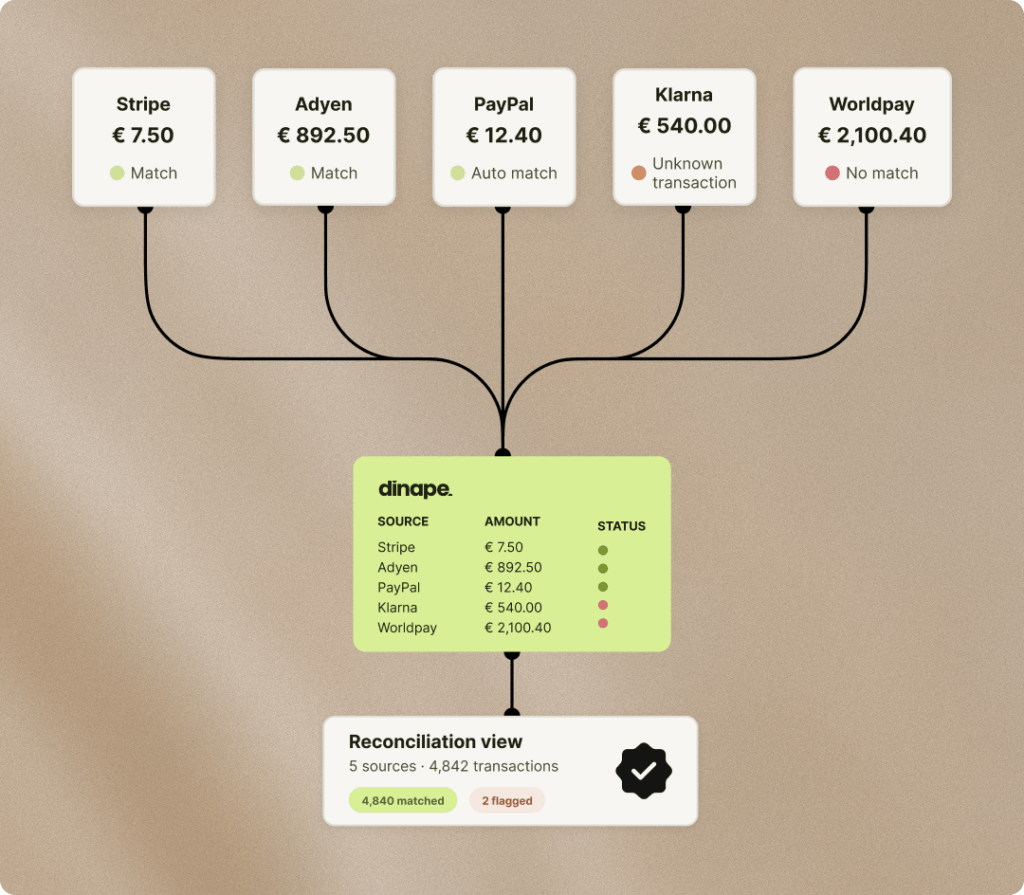
Dinape connects provider settlement data with transaction and connector data already managed within the platform. Instead of reconstructing payment records from exports across different systems, teams can compare transaction and settlement information within one reconciliation workflow.
The process follows four steps:

- Collect payment data from connected providers.
- Standardize different provider formats into one data structure.
- Match transactions, fees, settlements and payouts.
- Resolve discrepancies by making records that require attention clearly visible.
In Transactions reconciliation, teams can review transaction and settlement values side by side. Reconciliation statuses provide immediate context:
- Match – Dinape and provider values match.
- Auto-Match – a difference falls within a configured tolerance.
- No Match – a difference exceeds the allowed tolerance.
- Unknown transaction – a provider transaction cannot be matched to a Dinape transaction.
- Manual Match – a transaction has been reviewed and manually marked as matched.
Instead of checking every transaction individually, teams can focus on the exceptions that require investigation.
See the Reconciliation Data Guide for the detailed workflow.
Can payment reconciliation be automated?
Yes – but automation should reduce manual work without removing visibility and control.
Dinape supports calculation jobs that can run automatically on a schedule or be triggered manually. Reconciliation rules can also define acceptable fixed or percentage deviations by currency.
This helps teams distinguish expected differences, such as rounding or currency-related variations, from discrepancies that require investigation.
Relevant transaction and provider information remains available in context, allowing teams to focus on exceptions rather than manually reviewing every payment.
The goal is to automate routine matching while keeping exceptions visible and actionable.
From reconciliation to reliable payment operations
As businesses add providers, markets or merchants, a consistent reconciliation process helps prevent operational complexity from growing at the same pace.
Because ultimately, reconciliation is not about matching records for its own sake. It is about knowing what happened to every payment and giving teams the context they need to act.
Reconciliation is the control point. Reliable payment operations are the outcome.
Explore the Dinape Platform Overview to see how reconciliation fits into a connected payment workflow.
Ready to simplify payment reconciliation and gain greater control over your payment operations?

©Dinape 2026