Payment orchestration is entering a new phase.
Originally designed to route transactions between multiple PSPs, it is now evolving into something broader: payment decisioning across providers, payment rails, credentials, authentication, risk and settlement.
That shift matters because the payment landscape itself is changing. Businesses are no longer choosing only between PSP A and PSP B. They increasingly need to decide whether a transaction should use cards, wallets or account-to-account payments, how the payer should be authenticated, which credentials or mandates should be used, and how the payment should ultimately settle.
AI-driven commerce adds another layer. In 2026, the party initiating a payment may increasingly be an authenticated AI agent acting on behalf of a customer, introducing new questions around identity, mandate and merchant controls.
Payment orchestration is therefore becoming less about connecting payment providers and more about making the right payment decision in real time.
For global enterprises, payment service providers and marketplaces, that means greater control over an increasingly complex payment ecosystem – and the ability to adapt as payment methods, customer behaviour and transaction models continue to evolve.
What is payment orchestration and who is it for?
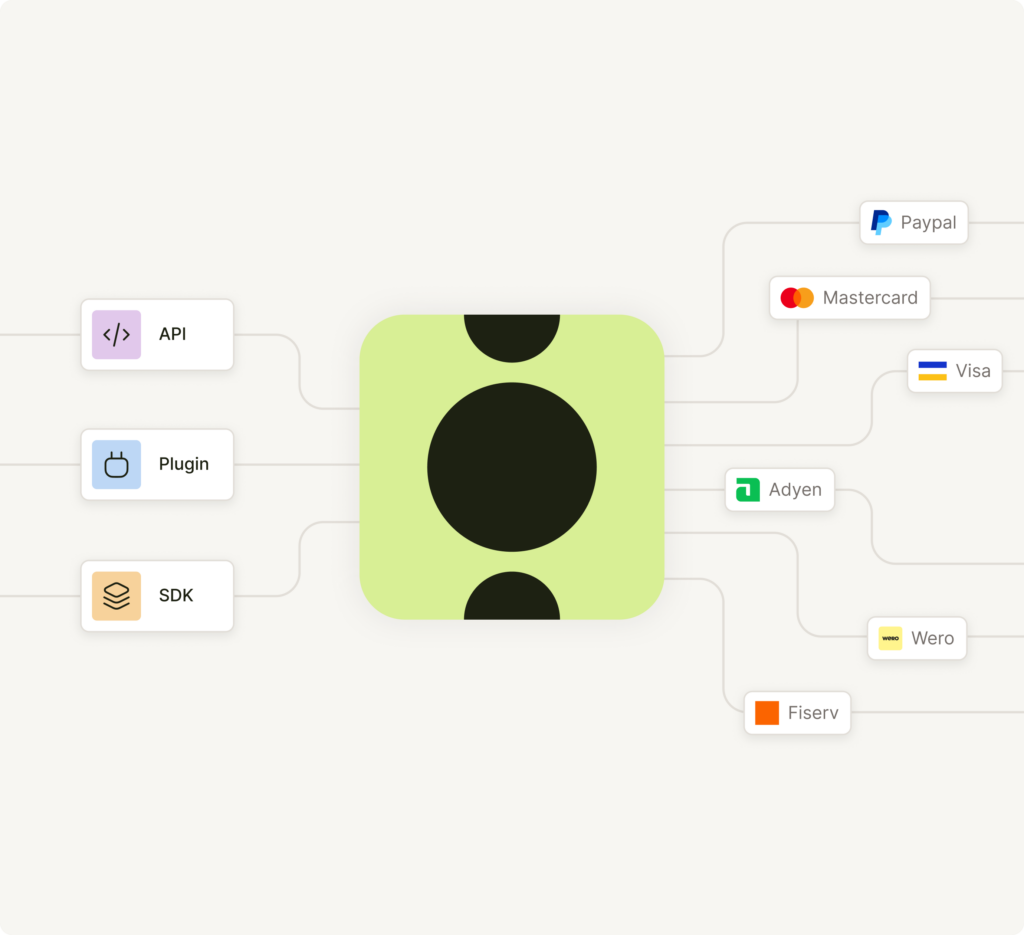
A payment orchestration platform helps global enterprises, payment service providers and marketplaces manage payments through one central infrastructure layer.
Unlike a payment gateway, which connects a business to payment processing, a payment orchestration platform can manage multiple PSPs, acquirers and payment methods through one central layer. A PSP provides payment processing services, while a payment orchestration platform connects and manages multiple PSPs and other payment services.
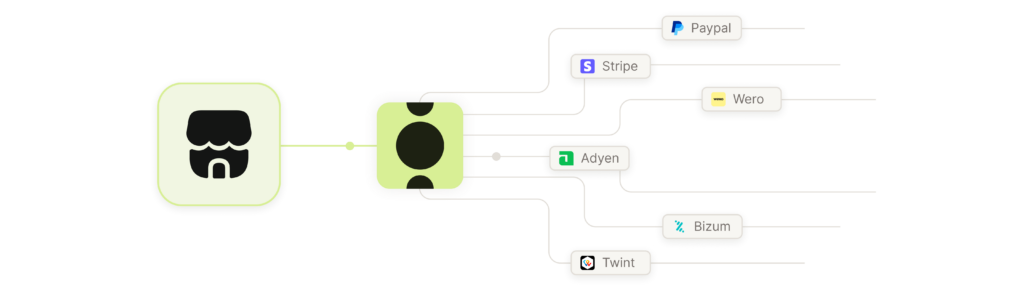
This can include PSPs, acquirers, alternative payment methods, fraud tools, tokenisation, reporting and reconciliation. The goal is to create a more flexible and provider-independent payment architecture.
Why does payment orchestration matter for merchants and payment teams?
A single-provider setup can be sufficient in the early stages of growth. But as businesses expand into new markets, payment requirements quickly become more complex.
The scale of this shift is significant. According to Worldpay’s Global Payments Report, global spending through digital payment methods across e-commerce and physical stores is expected to grow from $18.7 trillion in 2024 to more than $33.5 trillion in 2030, which is an increase of 79%. That implies roughly 10.2% CAGR from 2024 to 2030.
Consumer preferences are changing too, as digital wallets accounted for 56% of global e-commerce transaction value in 2025. For businesses operating internationally, supporting the right payment mix is therefore increasingly a market-by-market decision.
Europe provides a good example of how quickly that mix is evolving. Wero, the European digital wallet based on instant account-to-account payments, already serves 56 million users across Europe, according to EPI. It launched retail payments in Germany at the end of 2025, with a phased rollout expanding into France and Belgium during 2026, following earlier peer-to-peer availability in those markets.
This changes the orchestration challenge. The decision is no longer simply which PSP or acquirer should process a card transaction. Increasingly, businesses need to determine whether a transaction should use a card, wallet or account-to-account payment route, depending on the market, customer preference, cost, performance, and available infrastructure.
Different providers and payment rails can perform differently depending on geography, issuer, payment method, and transaction type. Payment orchestration gives businesses the flexibility to manage these options through one central layer, while reducing dependency on any single provider or payment route.
How does payment orchestration enable smarter payment routing?
One of the most important capabilities of payment orchestration is intelligent routing.
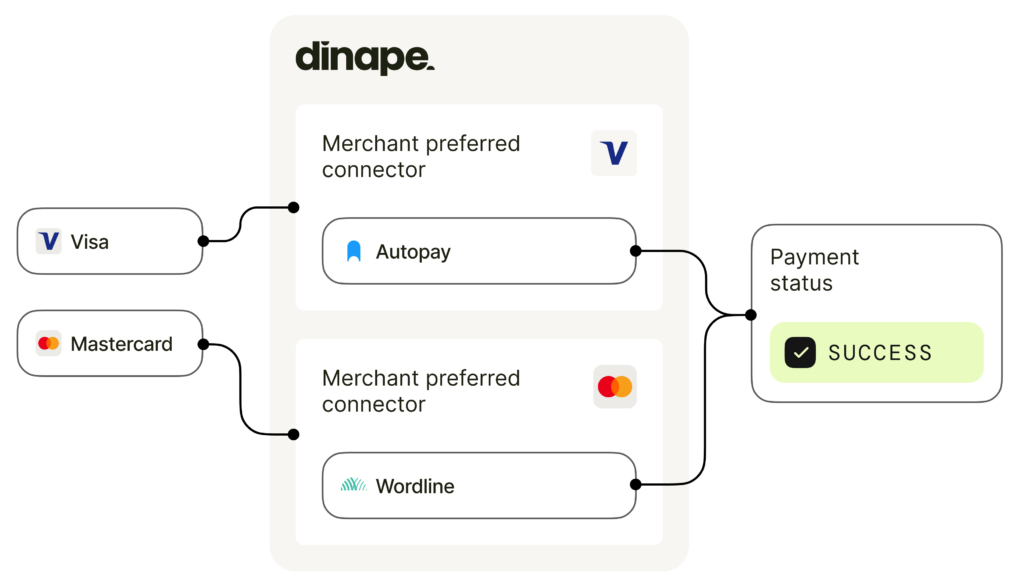
Instead of sending every payment through the same provider, transactions can be routed according to factors such as geography, provider performance, authorization rates, processing costs, payment method, transaction characteristics, and risk indicators. By directing transactions to the provider or payment rail that performs best for a particular market, payment method, issuer or transaction context, businesses can improve payment authorisation rates.
In 2026, another dimension is emerging: the payer may increasingly be an AI agent acting on behalf of the customer. Mastercard demonstrated a live authenticated agentic transaction in Germany in May 2026, based on an explicit customer mandate and strong authentication. Visa is similarly developing infrastructure for agentic commerce, including agent identification, tokenized payment credentials and customer-defined controls.
For payment orchestration, this introduces a new set of potential decision inputs. Alongside country, cost and risk, payment flows may increasingly need to consider who or what initiated the transaction, whether the agent is trusted, what the customer has authorized, and which controls the merchant has defined.
Intelligent routing is therefore evolving beyond selecting the best provider. It may increasingly orchestrate the wider context of the transaction – combining payment performance with identity, customer intent and merchant controls.
The optimal route depends on the business objective.
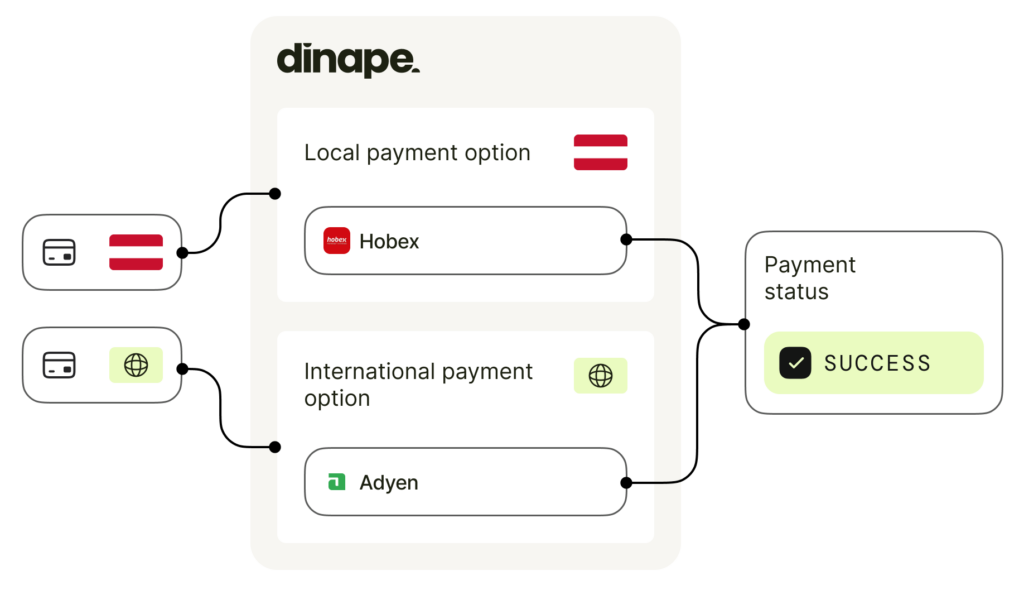
Some companies may prioritise approval rates. Others may focus more strongly on processing costs, resilience or specific market requirements.
Increasingly, however, payment orchestration is moving beyond choosing the best processor. The decision can also include which payment rail to use, which credential to present, how the customer should be authenticated and how the transaction should ultimately settle.
This is why the conversation is shifting from payment routing to payment decisioning. Rather than optimising a single processing path, the orchestration layer can evaluate the wider transaction context and determine the most appropriate combination of payment method, provider, authentication path and settlement route.
Dinape’s approach is built around this principle: using transaction and contextual information to determine the most suitable payment journey in real time.
How does payment orchestration improve payment resilience?
Payments are directly connected to revenue. If a payment provider becomes unavailable, every failed transaction can affect the customer experience and the bottom line.
And checkout is already a critical point in the customer journey. Baymard Institute currently puts the average documented online shopping cart abandonment rate at 70.22%, based on 50 studies. While abandonment has many causes, the figure reinforces the importance of keeping the checkout and payment experience as reliable and friction-efficient as possible.
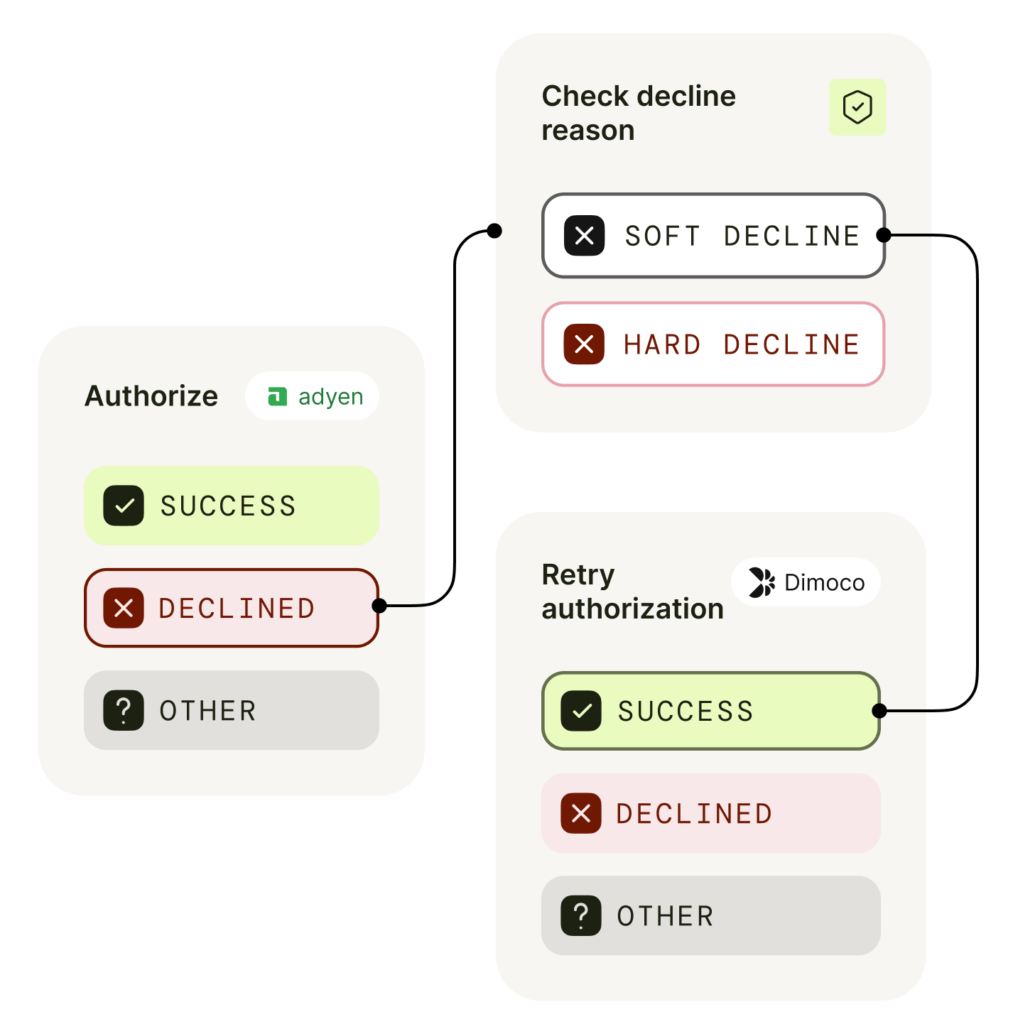
A multi-provider setup creates alternatives. Payment orchestration can redirect transactions to another provider when the preferred route is unavailable or underperforming.
This makes resilience part of the payment architecture rather than something that must be handled manually after a problem occurs.
How does payment orchestration increase provider flexibility and independence?
Payment orchestration reduces vendor lock-in. In a traditional setup, switching or adding providers can require significant technical effort. With an orchestration layer, businesses can connect providers as components within a broader payment ecosystem.
That makes it easier to introduce new PSPs, local acquirers, or payment methods without redesigning the entire infrastructure. It also gives businesses more flexibility when expanding into new markets.
How does payment orchestration improve visibility across payment operations?
Working with multiple providers often creates fragmented reporting.
Payment orchestration can provide a more centralised view across PSPs, acquirers and markets through a customizable merchant dashboard. This helps payment teams understand where approval rates are strongest, where declines are increasing, which providers perform best, how routing decisions affect costs, and where payment failures occur.
The objective is not simply to collect more payment data, but to use it to make better decisions.
How is payment orchestration evolving with AI and intelligent decisioning?
Payment routing has traditionally been based on predefined rules. Increasingly, AI and advanced analytics can make these decisions more dynamic.
Signals such as transaction history, device information, provider performance, identity data and risk indicators can be evaluated together to determine the most suitable payment path.
The value of AI in payment orchestration is therefore practical: better routing, smarter retries, faster detection of performance changes and more adaptive payment operations.
For enterprise e-commerce businesses operating across markets, this means managing multiple PSPs, acquirers and payment methods through a more flexible and resilient payment infrastructure. At that point, the question is no longer simply which payment provider to choose. It becomes a question of how the entire payment ecosystem should be designed.
How can businesses gain control over payment complexity?
The payments landscape will continue to evolve. New payment methods, regulatory requirements, and customer expectations will create more complexity rather than less.
In 2026, that complexity is also moving deeper into the payment stack. Stablecoin settlement is becoming more relevant to established payment networks: Visa reported an approximately $7 billion annualised stablecoin settlement run rate as of March 2026, while Stripe now explicitly describes stablecoin orchestration as a way to coordinate routing, conversion, settlement and reconciliation across different networks.
Europe is developing another potential settlement rail. In July 2026, the ECB selected 36 payment service providers to participate in its digital euro pilot, which is scheduled to begin in the second half of 2027.
The implication for payment orchestration is broader than the adoption of any single new technology. Just as orchestration increasingly abstracts the acceptance layer across cards, wallets and account-to-account payments, it may also begin to abstract the settlement layer, allowing businesses to manage different ways of moving and settling value through one decisioning framework.
Payment orchestration therefore gives businesses a way to manage complexity more intelligently: connecting providers and payment rails, optimising payment decisions, improving resilience and maintaining greater control over an evolving payment infrastructure. As a payment orchestration provider, Dinape helps businesses build payment ecosystems that are flexible, scalable and designed around their own strategic priorities.
©Dinape 2026
Want to understand where payment orchestration could improve your current payment setup?