How can payment teams manage risk with less effort?
Too many manual checks, fragmented controls and unclear payment blocks make risk management harder than it needs to be.
Dinape Risk Management helps payment teams reduce manual reviews, investigate risks faster and apply consistent controls through configurable rules and transparent risk scoring. Teams gain more control over transaction decisions and clearer context when a payment needs attention.
What are the benefits of payment risk management?
Payment risk management helps businesses assess transaction risk and decide whether a payment should continue. For payment teams, the practical benefits are less manual work, consistent controls and faster investigations.
With Dinape, teams can:
- Reduce manual effort: Automatically evaluate transactions against configured risk rules.
- Adapt controls: Set rules and thresholds at client, division or merchant level to reflect different business requirements.
- Investigate faster: Use visible Risk Scores and rule contributions to understand what influenced a decision.
- Refine decisions over time: Adjust controls as transaction patterns and risk requirements change.
This helps teams focus their attention on transactions that need investigation while routine assessments run automatically.
How does Dinape Risk Management work?
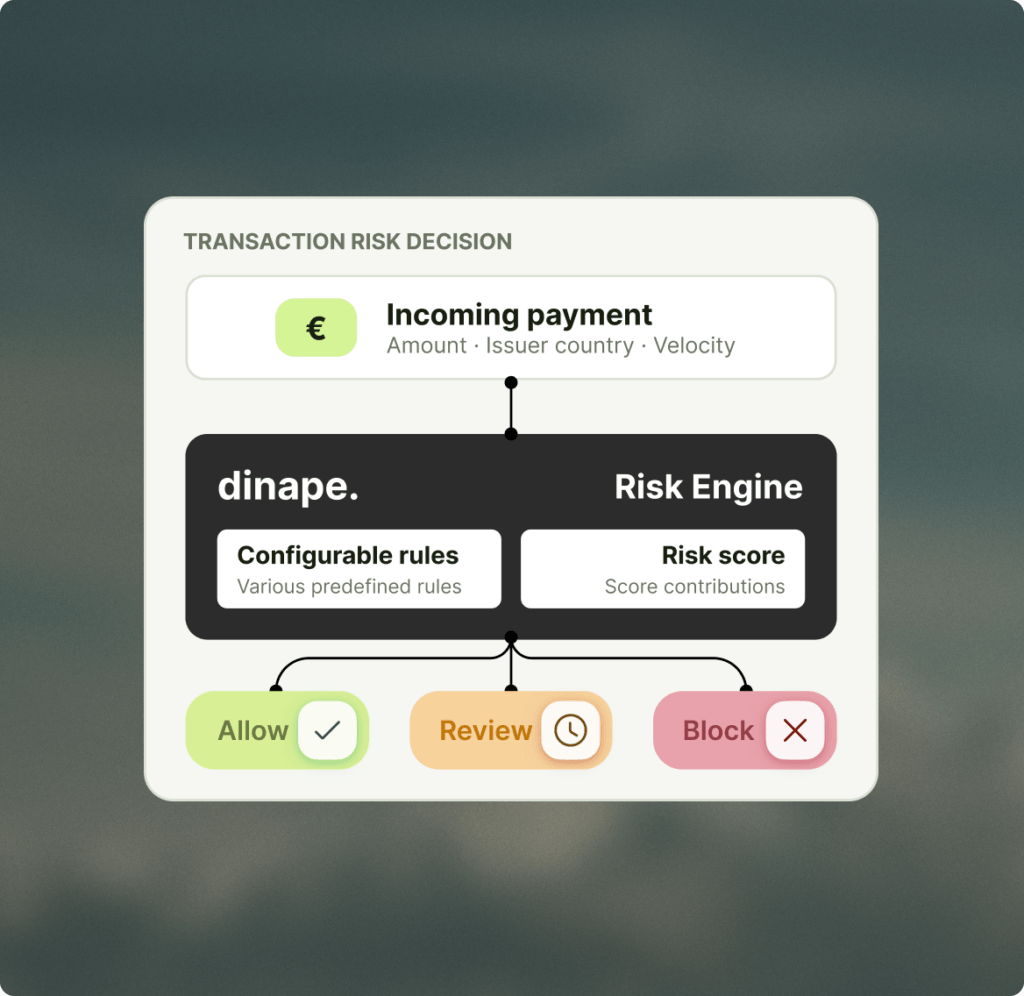
Dinape evaluates transactions against predefined risk rules configured by the business. Teams set the relevant controls and thresholds, then the risk engine applies them automatically.
Triggered rules contribute to a Risk Score. Dinape uses the configured thresholds to automatically approve or block the payment.
Teams can analyse the score contributions and decision reasons to understand the outcome and refine their configuration. This gives them a repeatable process for applying their risk policies as transaction volumes grow.
How can teams understand why a payment was blocked?
A blocked payment creates work when the reason is unclear. Operations and Support teams need enough context to investigate and respond.
Dinape makes Risk Scores and rule contributions visible, helping teams identify the conditions behind a risk decision. This gives them a clearer starting point for investigations and helps Risk teams assess whether their controls need adjustment.
Within Dinape’s payment orchestration platform, risk evaluation remains connected to the transaction and the wider payment flow, keeping decision context available for payment operations.
How can payment teams take greater control of payment risk?
Greater control starts with rules that reflect the business and decisions teams can explain.
Dinape combines configurable controls, automatic transaction evaluation and transparent scoring to help teams spend less time on manual checks and investigate risk decisions faster.
Download the Dinape Risk Management Fact Sheet to explore how it works.
Ready to simplify your payment risk management?
Discover how Dinape can help your team reduce manual checks, investigate risks faster and stay in control of payment decisions.